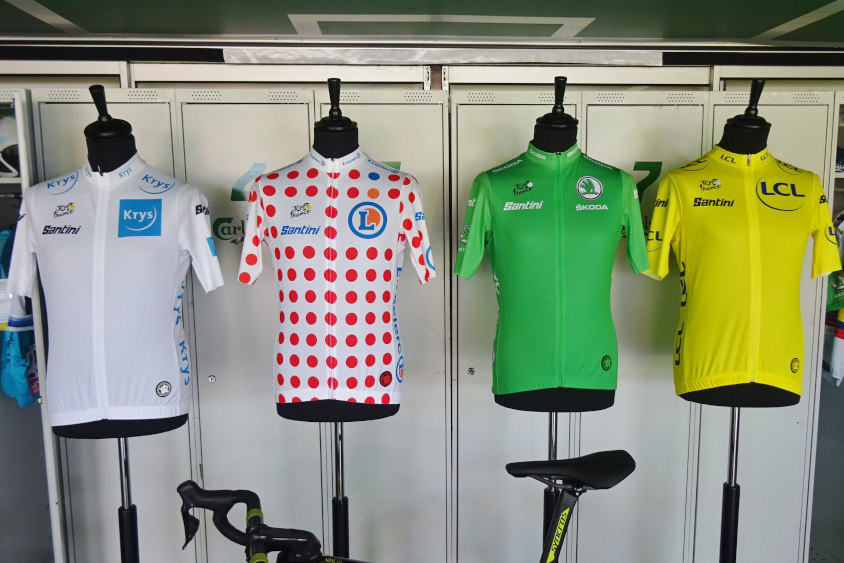
The four jerseys awarded at the Tour de France and Tour de France Femmes avec Zwift. Credit: Creative Commons
The Tour de France is the annual three-week bike race that commands the world's attention and focuses it on professional bike racing. The yellow leader's cycling jersey is nearly synonymous with winning this most prestigious event, but there are other jerseys, prizes, and awards on offer.
The maillot jaune is worn by the overall race leader; however, other in-race competitions, such as King/Queen of the Mountains, Points, and Best Young Rider (under 25 years old), also have specific jerseys to signify the leader in those races.
Why Trust Us?
ACTIVE.com's editorial team relies on the knowledge and experience of fitness and wellness experts, including competitive athletes, coaches, physical therapists, nutritionists, and certified trainers. This helps us ensure that the products we feature are of the highest standard. Collectively, the team has spent countless hours researching equipment, gear, and recovery tools to create the most accurate, authentic content for our readers. Customer satisfaction is also a key part of our review process, which is why we only feature highly rated products.
Jerseys also allow race officials to quickly and easily identify riders, and make it easier for fans and cameras to follow them.
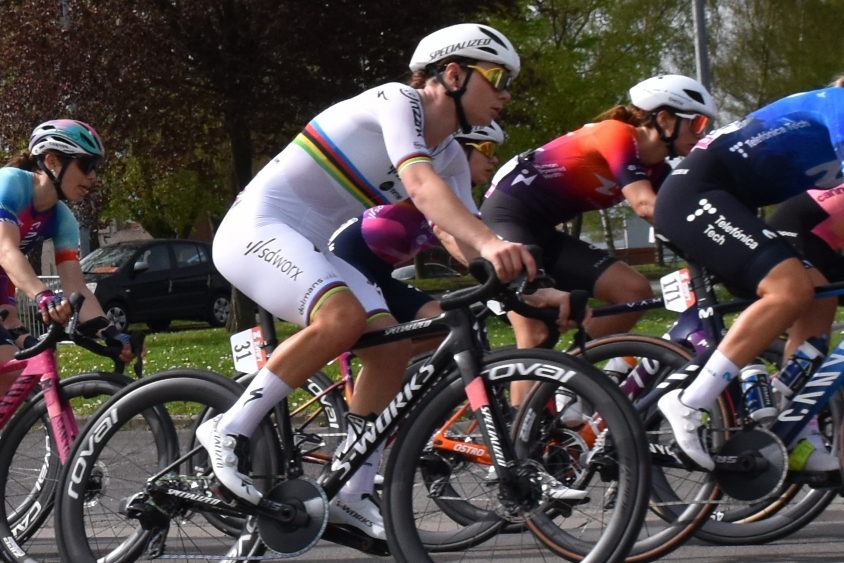
Belgian Lotte Kopecky wearing the world road champion's jersey. Credit: René Hourdry/CC
A Rainbow of Jerseys
The world champion's rainbow jersey — usually having a white background with a blue-red-black-yellow-green band — sits outside of the Tour de France competition, as do other special jerseys. But when racing at the Tour, race jerseys may supersede all other jerseys and designations.
Other special jerseys include the continental champions' jerseys (Americas, Europe, Asia, Africa) and the respective national champions' jerseys. Riders who are previous winners of the Olympics, world, continental, and national championships are entitled to wear these colors as bands on the cuffs of their jerseys.
Race jerseys designating the Tour's category leaders must be worn instead of official team uniforms or other special jerseys. Teams at the Tour whose riders are leading a competition and wearing a race leader jersey can display their sponsors, as long as they don't clash with the Tour's color schemes.
In fact, race jerseys at the Tour de France are so significant that if a team's standard colors used throughout the season (i.e., yellow) are similar in color to a race jersey worn at the Tour de France, teams are required to wear special edition uniforms so as not to be confused with a race-issued jersey.
Following each of the 21 stages at the Tour, the day's winner is recognized, and the leaders of the overall, points, climbing, and best young rider competitions, with their respective jerseys, are also afforded a podium presentation. Tour de France jerseys can change hands daily, but the one that matters most is the one worn at the conclusion of the Tour, after the 21 stages.
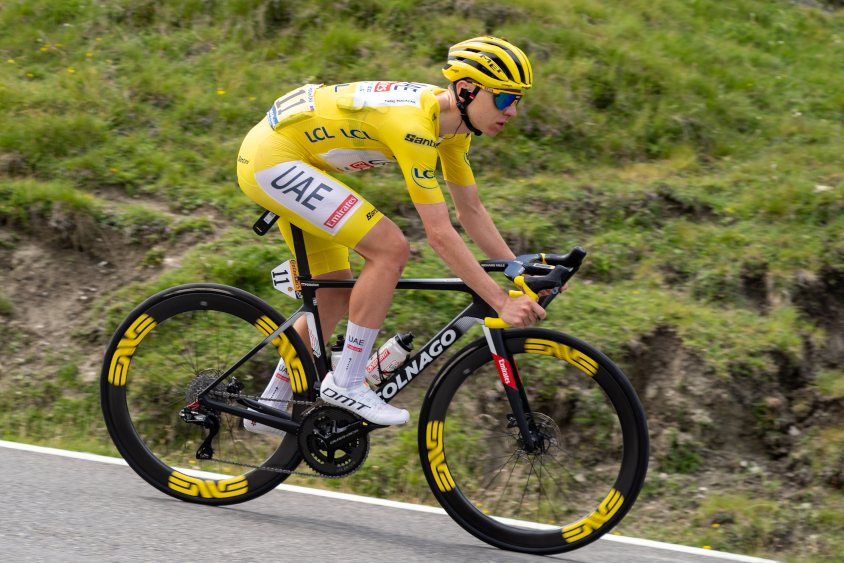
Slovenian Tadej Pogačar in the race leader's yellow jersey. Credit: Hugo Luc
Yellow Jersey
The yellow jersey is worn by the overall (general classification or GC) race leader. To win the yellow jersey, a rider must be adept at climbing, masterful at descending at speeds greater than 100kph (60mph), and supremely aerodynamic in individual time trials.
A rider must also be powerful enough to sprint to the line after hours of racing, day in and day out, have luck on their side, and have a team strong enough to support them across three weeks and thousands of kilometers of grueling terrain in the summer heat. Curious how the rest of the field supports that effort? Here's more on the domestiques and teammates who make it possible.
The yellow jersey commands honor of the rider who wears it and the respect of the peloton. If the yellow jersey stops for a nature break, the entire race stops with them. While not a hard-and-fast rule, if a rider crashes while wearing yellow, the peloton may slow to allow the rider to recover and rejoin the group.
I was riding with the strength of two men.
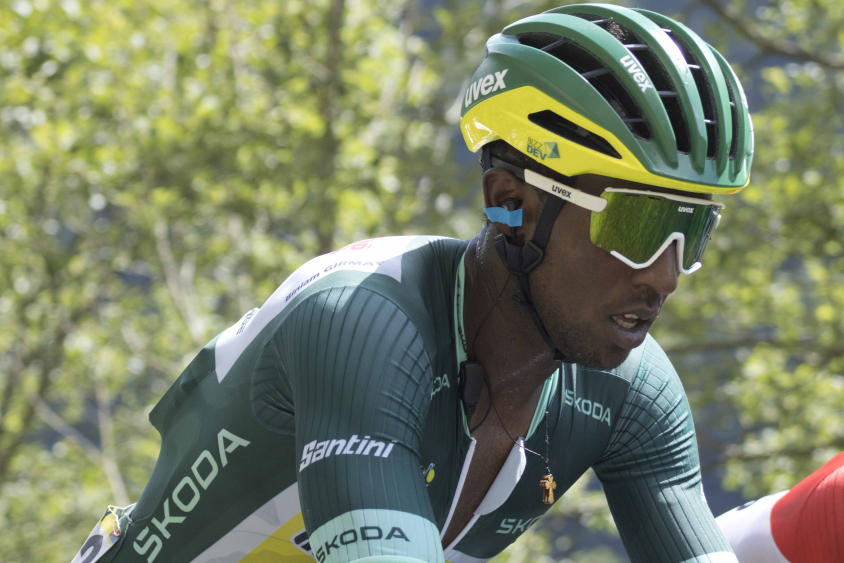
Eritrean Biniam Ghirmay, points classification leader in the green jersey. Credit: Filipi Bossuyt/Creative Commons
Green Jersey
The rider donning the green jersey leads the points competition. Points are awarded at the end of each stage, a nod to consistency over three weeks of racing. The points competition may also offer points mid-stage, but they are not as valuable as those at the finish. Different stages offer varying amounts of points for the green jersey competition, with the largest award usually on offer for winning the 21st stage.
In recent years, the points race became a sprinter's competition. Teams targeting the green jersey often have formidable sprint leadout trains.
In the final few kilometers of a stage, these leadout trains will line up riders single file, with their designated sprinter the last rider in this train. The frontmost rider will take a turn leading the train at ferocious speed, and when they are exhausted, they will cautiously swing off to the side. This allows the next rider, who was in a slipstream and conserving energy, to go all out and maintain a very high overall speed.
Quick Tip
This scenario repeats until the final rider in the train is delivered to a predetermined distance, at which point they launch out of their team's slipstream to try to take the win. This is all happening at speeds in excess of 75kph (46mph) for stages with flat finishes in the men's race, and more than 60kph in the Tour de France Femmes.
If a rider loses their leadout for whatever reason, or their team could not get into formation for a leadout, they may try to freelance their way to a win. This is done by drafting other riders and slotting behind their slipstreams, who are also trying to do the same. Generally, riders from one team do not try to interrupt other teams' leadout trains out of courtesy and a respect for safety.
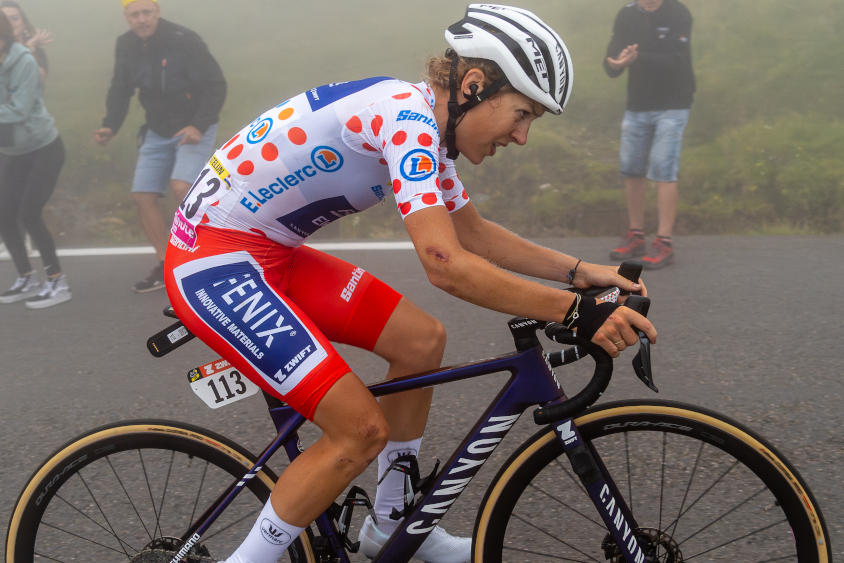
Yara Kastelijn of the Netherlands showing off her QOM polka-dot jersey. Credit: Creative Commons
Polkadot Jersey
Polkadots are worn by the cyclist who has amassed the most points in the climbing (KOM/QOM) competition.
Higher-categorized climbs, which are rated by length and gradient, offer more points than lower-categorized climbs. Climbs are rated Category 4 (easiest) to Hors catégorie (HC/beyond category, or hardest). The harder the climb, the more points it's worth.
Riders targeting the polkadot jersey are frequently smaller riders, with advantageous strength-to-weight ratios measured in watts per kilogram. One of the requisite skills for winning the Tour is climbing, so it's not unusual for the overall race leader to also carry the climbing competition. If you want to ride some of these iconic ascents yourself, check out these Tour de France stages worth riding for fun.
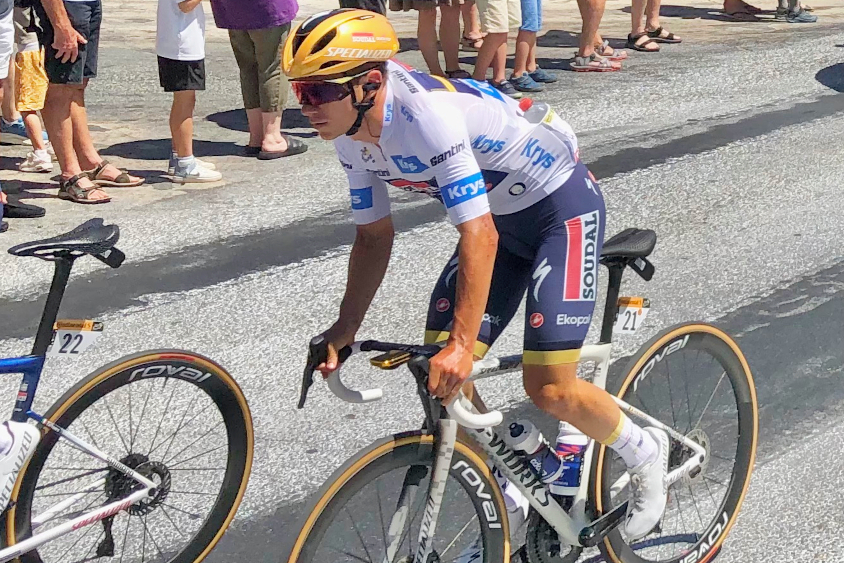
Belgian Remco Evenepoel wearing the white jersey of the best young rider. Credit: Rundvald/CC
White Jersey
The white jersey is awarded to the best-placed rider under 25 years old. Since this is an age-restricted competition not available to the entire peloton, the white jersey is the lowest relative priority. However, it could be considered a yellow jersey light, and winners of the white jersey may go on to take the yellow jersey in subsequent years.
Notable Tour de France Jersey Rules
A rider can win more than one jersey, but since they can only wear one jersey at a time, the next-best-placed rider in a specific competition wears the jersey for that competition. For example, the overall race leader (yellow) may also have the most climbing points and so is also entitled to wear polkadots. Since the yellow jersey takes precedence, the rider placed second in the climbing competition wears the polkadot jersey on loan from the overall leader.
Wearing a designated jersey at the Tour comes with responsibilities. Riders wearing jerseys must be available for interviews, and since each jersey has a specific commercial sponsor, sponsors may ask riders to sign replicas, make themselves available for photos, socialize with official guests, and more.
Riders may be penalized (monetary fines, docked race and annual ranking points) for not appearing in a jersey which they've won, or shirking jersey responsibilities. This scrutiny may also apply to other jerseys, like the continental and world champion's stripes.
Two other official competitions are on offer at the Tour but carry no associated jersey: the combativity award and team award. The combativity award is presented after each stage to the rider who animates it — such as by driving the breakaway — and is signified by a golden number worn by that rider on the following stage. It's also awarded to the most aggressive rider at the conclusion of the Tour. The team award, also presented daily and at the conclusion of the Tour, is presented to the squad with the lowest aggregate time for its top three best-placed riders.
Want more background on the race itself? Check out these common Tour de France questions, answered, or brush up on the rules riders follow at the Tour de France.
Frequently Asked Questions
What does the yellow jersey mean in the Tour de France?
The yellow jersey, or maillot jaune, is worn by the overall race leader based on cumulative time across all stages. It's the most prestigious jersey at the Tour, and the rider wearing it at the finish in Paris is crowned the overall winner.
What is the green jersey for in the Tour de France?
The green jersey is awarded to the leader of the points classification, which rewards consistency and sprinting ability across the three-week race. Points are awarded at stage finishes and, in some stages, at intermediate sprint points.
What is the polka-dot jersey in the Tour de France?
The polka-dot jersey goes to the leader of the King or Queen of the Mountains (KOM/QOM) competition. Riders earn points by being the first to crest categorized climbs, with harder climbs worth more points.
Who can wear the white jersey at the Tour de France?
The white jersey is reserved for the best-placed rider under the age of 25 in the overall general classification. It highlights rising talent and has historically been worn by riders who later go on to win the yellow jersey.
Can one rider wear more than one Tour de France jersey?
A rider can lead multiple competitions at once, but can only wear one jersey at a time. The yellow jersey takes precedence over all others, so if the overall leader also leads another competition, that jersey passes to the next-best-placed rider in that category.
About the Author

Get ACTIVE on the Go


Couch to 5K®
The best way to get new runners off the couch and across the finish line of their first 5K.
Available for iOS | AndroidLatest In Cycling


Trending Articles
-

How to Stay Hydrated While Cycling
-
How to Recover After a Triathlon: Complete Post-Race Recovery Plan
-
COROS Wants to Turn Your Training Data Into Answers, Not Just Charts
-
The Best Beginner Bikes of 2026: What to Buy (and What to Skip) for Every Kind of Rider
-
Nekteck Leg Massager Review: Worth It for Recovery?





Discuss This Article