
A pro golfer’s bag isn’t just equipment. It’s a strategy.
Every club has a job. Every decision is intentional. Nothing is random. Because at that level, golf isn’t just about talent. It’s about preparation.
Why Trust Us?
ACTIVE.com's editorial team relies on the knowledge and experience of fitness and wellness experts, including competitive athletes, coaches, physical therapists, nutritionists, and certified trainers. This helps us ensure that the products we feature are of the highest standard. Collectively, the team has spent countless hours researching equipment, gear, and recovery tools to create the most accurate, authentic content for our readers. Customer satisfaction is also a key part of our review process, which is why we only feature highly rated products.
To someone watching from the outside, it might look like overkill. Four wedges. Multiple woods. The same club in slightly different setups. But pros aren’t packing for convenience. They’re packing for performance.
Think about it. Every course presents different conditions, and the weather can shift at any moment. Wind changes. Temperatures fluctuate. Course conditions evolve throughout the round. What starts firm can soften. What plays fast can slow down. Every round brings new lies, pressure moments, and variables. The bag is built to handle it all.
Understanding what’s inside a pro’s bag isn’t just about curiosity. It reveals how elite players think about the game. They don’t rely on improvisation. They prepare for outcomes before they happen.
Think of this as a sneak peek. You don’t need to carry everything a pro does. But with 4 to 5 hours on the course, a little preparation can go a long way.
Golf ClubsA Driver
The driver is built for distance, yes but for pros, it’s really about precision at speed.
Tour players don’t just swing hard. They swing consistently. Their drivers are customized for launch angle, spin rate, shaft length, and shot shape to their swing and course strategy.
It’s not about hitting bombs. It’s about placing the ball in the right position to set up the next shot, turning distance into opportunity rather than risk.
Fairway Woods
Usually a 3-wood or 5-wood, fairway woods come into play when the driver isn’t the smartest option. Tight fairway. Long par 5. Windy conditions. These clubs give pros distance with more control.
- 3-wood: Typically used off the tee or for long second shots on par 5s
- 5-wood: Often used for slightly shorter approaches or when a higher launch is needed
Fairway woods can be used both off the tee and from the fairway when a long, controlled shot is required.
Irons
Most pros carry irons from a 3- or 4-iron down to a pitching wedge, often replacing the longest irons with hybrids for easier launch and forgiveness. Each club is dialed in for exact distances to help control trajectory and attack the green with confidence.
Typical iron (and hybrid) distances:
- 3 Iron / Hybrid: ~190–220 yards
- 4 Iron / Hybrid: ~180–210 yards
- 5 Iron: ~170–200 yards
- 6 Iron: ~160–190 yards
- 7 Iron: ~150–175 yards
- 8 Iron: ~140–165 yards
- 9 Iron: ~130–155 yards
- Pitching Wedge: ~110–140 yards
Together, irons and hybrids help pros transition from distance into scoring range.
Wedges
Typically, a pro carries four wedges. Each golf wedge has a specific loft angle and purpose:
- Pitching Wedge (44–48°): Typically used from about 110–140 yards
- Gap Wedge (50–54°): Typically used from about 90–110 yards
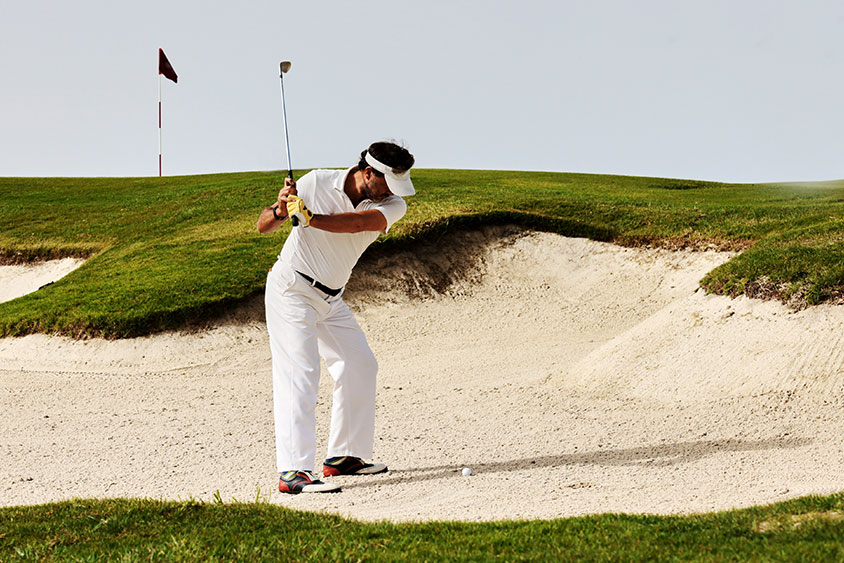
- Sand Wedge (54–58°): Typically used from about 70–90 yards and bunker shots
- Lob Wedge (58–64°): Typically used from about 30–70 yards, for short-sided shots, and high, soft approaches
These aren’t interchangeable clubs. They’re precision tools used for short approaches, bunker shots, flop shots, spin control, and saving par when things don’t go as planned.
Pros pay close attention to wedge gapping—spacing the loft angles so each club covers a consistent distance range. This allows them to take controlled swings instead of constantly guessing or forcing shots.
Bounce also plays a major role. The bounce angle affects how the club interacts with turf or sand. Higher bounce helps prevent digging in softer conditions or bunkers, while lower bounce can be useful on firmer turf where a cleaner strike is needed.
This level of detail matters because most tournaments aren’t won with the driver. They’re won from 120 yards and in, where control, trajectory, and spin determine scoring opportunities.
A Putter
This is the only club used on every hole, and it’s the most individualized. Blade or mallet. Face-balanced or toe-hang. Insert or milled face.
Pros choose putters based on feel, stroke type, and alignment preference. A blade often suits players with more arc in their stroke, while a mallet can provide added stability and forgiveness. Face-balanced putters help minimize rotation, while toe-hang designs allow for more natural face movement through impact.
Putting is feel-driven. Confidence-driven. And it’s where consistency beats power.
Golf Balls
Yes, the type of golf ball matters. Pros choose golf balls based on spin, feel, launch, and greenside control—and they don’t switch casually. A ball choice affects everything from driver distance to wedge spin to putting feel.
Generally speaking, golf balls fall on a spectrum from soft to firm.
Softer balls tend to offer more feel and control, especially around the greens. They’re often preferred by players who want more spin on approach shots and better touch on chips and putts.Firmer balls typically produce more distance and lower spin off the tee. They’re designed to help maximize ball speed and provide a more penetrating flight.
Pros select the ball that complements their swing and playing style—balancing distance off the tee with control into the green.
Other Golf Essentials & Accessories
Here are some of the extras you might not think about because performance isn’t just about the swing. It’s about readiness.
Ball Marker
A small but essential tool used on the green to mark the position of the ball when it’s lifted. Pros often use simple coins or custom markers.
Divot Tool (Pitch Mark Repair Tool)
Used to repair ball marks on the green, this tool helps maintain smooth putting surfaces. Fixing pitch marks is not just a matter of etiquette. It helps preserve the quality of the greens for everyone playing behind you.
Snacks & Hydration
Tournament golf isn’t just technical. It’s physical. Pros walk miles during a round. Add warm-ups, range sessions, and weather conditions, and you’re looking at an endurance effort. br/>
Low energy doesn’t just make you tired—it impacts decision-making, swing tempo, and focus. That’s why most pro bags include protein bars, bananas or fruit, nuts or trail mix, peanut butter packets, jerky, electrolyte drinks or powders, and water bottles.
Hydration and steady fuel help maintain consistency—and consistency is everything in golf.
Rangefinder
When allowed, a rangefinder helps players quickly confirm yardage and make confident club selections.
Yardage Book
Even with modern tech, the yardage book is a staple. It provides detailed course notes, green slopes, hazards, and landing zones that guide strategy on every hole.
Multiple Gloves
Grip matters. Pros carry extras to swap out during humidity, sweat, or rain to maintain feel and control.
Rain Gear
The weather changes fast. Lightweight waterproof layers keep players dry without restricting movement.
Golf Tees
Yes, pros carry tees—and not just one type. Different tee heights are used depending on the club and the shot they want to hit. A higher tee is typically used with the driver to help promote optimal launch and distance. Shorter tees are often used for fairway woods or irons off the tee when control matters more than height.
Tee height may seem like a small detail, but it directly impacts launch angle, spin, and consistency.
Towels
Usually more than one. Towels are used to keep clubs, hands, and grips clean and dry throughout the round.
Sunscreen & Chapstick
Long days on exposed courses take a toll. Protection from the sun and wind helps players stay comfortable and focused from the first tee to the final putt.
It’s Not Just Gear
A pro’s bag isn’t about having more tools. It’s about having the right tools—and knowing when to use them.
Every club exists to solve a specific problem: distance, accuracy, recovery, control, and yes, energy.
Golf, like any performance-driven discipline, rewards preparation. The pros don’t wing it. They build a system that sets them up to succeed before they even step onto the tee box. And that’s something every athlete—weekend golfer or otherwise—can learn from.
About the Author

Fara Rosenzweig is a certified fitness instructor, behavioral change specialist, and golf fitness specialist with a passion for helping people build sustainable strength and confidence—on the course and beyond. She’s completed 50+ half marathons and two IRONMAN 70.3 races, is an Emmy Award winner, an avid golfer, a yogi, and a devoted dog mom.
Get ACTIVE on the Go


Couch to 5K®
The best way to get new runners off the couch and across the finish line of their first 5K.
Available for iOS | Android







Discuss This Article