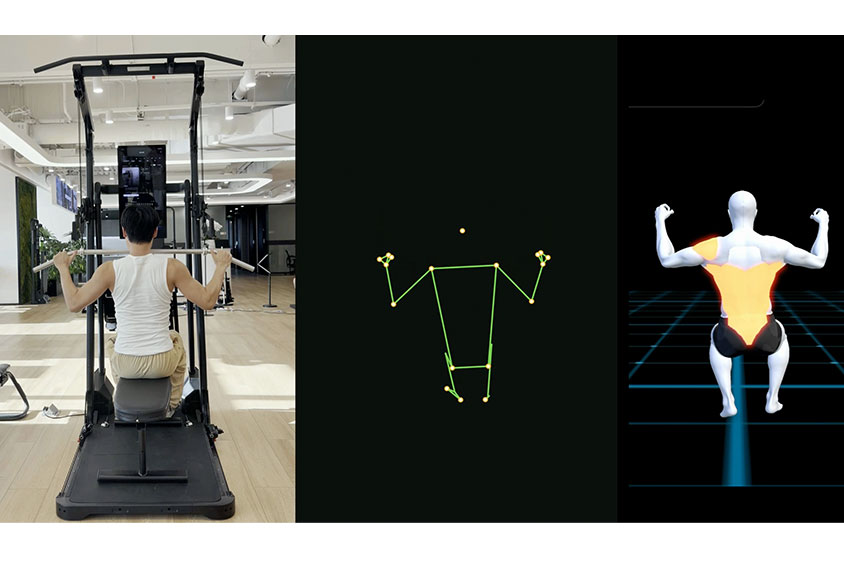
Quick answer: Speediance, the company behind the Gym Monster smart home gym, is introducing three proprietary AI models, Votus, Oryn, and Somni, along with AEVIS, a proactive AI agent meant to carry training and recovery context from one day to the next. The announcement also includes new hardware: Gym Monster 3, Gym Monster Ultra, Gym Nano, and the Speediance Strap, a screen-free recovery wearable.
Why Trust Us?
ACTIVE.com's editorial team relies on the knowledge and experience of fitness and wellness experts, including competitive athletes, coaches, physical therapists, nutritionists, and certified trainers. This helps us ensure that the products we feature are of the highest standard. Collectively, the team has spent countless hours researching equipment, gear, and recovery tools to create the most accurate, authentic content for our readers. Customer satisfaction is also a key part of our review process, which is why we only feature highly rated products.
Speediance built its reputation on the Gym Monster, a compact cable-based home gym that's earned a loyal following since launching on Kickstarter in 2021. This announcement is the company's clearest signal yet that it sees its future as something bigger than a single piece of hardware: a connected system where AI, movement data, recovery signals, and training equipment all feed into each other.
That's an ambitious pitch, and it comes with some important fine print. Here's what Speediance is actually announcing, what's available now, and what's still on the roadmap.
What Are Speediance's Three New AI Models?
Rather than building one all-purpose AI, Speediance split the problem into three separate models, each handling a different part of the training process.
Votus: Understanding How You're Moving
Votus is Speediance's movement-intelligence model. Using nothing more than a phone camera, it's designed to reconstruct a person's movement in 3D and analyze exercise execution while the movement is happening, adding information like repetition speed and velocity-based training data to more conventional workout metrics. Speediance is currently demonstrating Votus inside its own fitness ecosystem, not as standalone software already deployed in gyms generally.
Oryn: Training and Recovery Decisions
Oryn is described as a foundation model covering exercise, nutrition, and sleep. Instead of just spitting out a workout from a prompt, it's meant to function as a decision layer, weighing a broader picture of the user before recommending whether to stick with a planned session, adjust the load, shift the workout's focus, or prioritize recovery instead. The underlying idea is treating training as a continuous process rather than a series of disconnected workouts.
Somni: Modeling Possible Future States
Somni is the most speculative of the three, explicitly labeled a technology preview. It explores how different training and recovery choices might influence future states like fatigue, sleep, appetite, and trainable capacity, reasoning across multiple possible trajectories rather than predicting one fixed outcome. Speediance is explicit that Somni is not a medical device and isn't intended to diagnose, treat, cure, or prevent any disease, worth keeping in mind given how easily "AI health model" language can be misread as clinical.
Quick Tip
What Is AEVIS, and How Is It Different From a Fitness Chatbot?
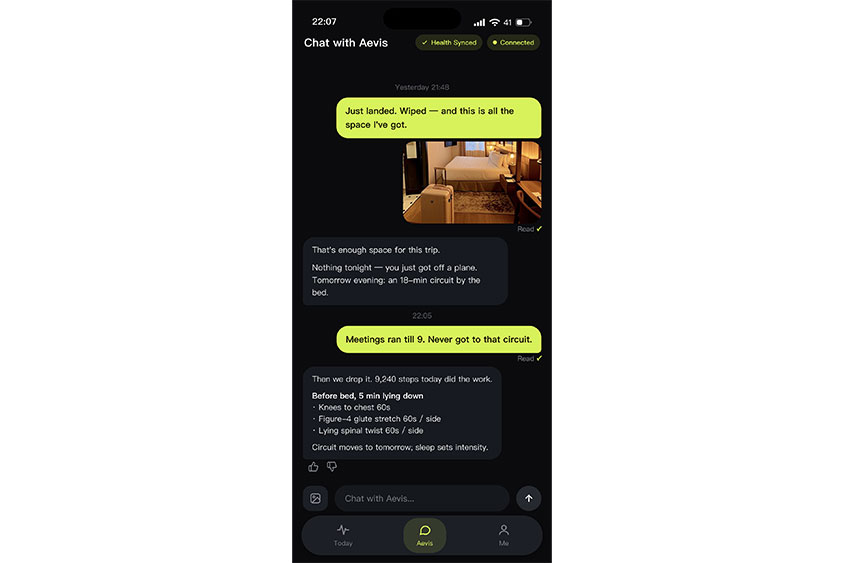
AEVIS is the layer meant to tie Votus, Oryn, and Somni together over time. Where a typical fitness chatbot answers one question and forgets the context by the next session, AEVIS is designed to hold onto training history, available physiological and recovery signals, sleep, nutrition, and daily schedule, and let that context shape what it recommends next.
Speediance demonstrated the idea with a travel scenario: a user tells AEVIS about an upcoming six-hour round-trip drive, and the system responds by trimming the planned training load and shifting emphasis toward sleep and recovery around the trip. After the workout, AEVIS reportedly used the session data, movement video, and heart-rate readings to reassess the user's condition, adjusting the next plan toward mobility and active recovery instead.
The specific recommendations in that demo matter less than the underlying goal: carrying context from one workout, one day, or one schedule change into the next decision, rather than starting from a blank slate every time you open the app.
Continuity means allowing relevant context from one workout, one day or one change in schedule to inform what happens next without requiring the user to start from scratch each time
How Close Is Speediance to Connecting AI Directly to Training Hardware?
Speediance is also previewing what it calls embodied intelligence, a four-part loop it summarizes as Sense, Decide, Act, Learn. In theory, the system gathers information about the user and the workout, AI interprets it, and the training hardware itself increasingly becomes a physical execution and feedback layer, with workout results feeding new information back into the system.
Here's the important caveat, stated plainly in Speediance's own materials: AEVIS does not currently autonomously control Gym Monster resistance. That deeper integration between the AI systems and the physical hardware remains part of the company's longer-term roadmap, not something available today. It's a meaningful distinction, since it separates what Speediance is shipping now from what it's still building toward.
What New Hardware Is Speediance Launching?
Alongside the AI announcements, Speediance is introducing four new pieces of hardware:
- Gym Monster 3: The next-generation home training platform, offering up to 220 pounds of digital resistance across 19 cable positions in a freestanding design that doesn't require wall mounting
- Gym Monster Ultra: The flagship system for more advanced strength training, stepping up to 260 pounds of digital resistance, plus a vertical high-lat pulldown, multi-grip pull-up setup, adjustable thigh restraint, and 33 cable positions
- Gym Nano: A portable, 8.2-kilogram system still capable of up to 220 pounds of resistance, with real-time velocity and power data and performance assessments including peak force, rate of force development, and left-right asymmetry
- Speediance Strap: A screen-free wearable using greenteg Calera technology to track core body temperature trends at the wrist, intended to add context around training, recovery, sleep, and heat load. Speediance does not position the Strap as a diagnostic device
Each product covers different ground, from home strength training to portable performance assessment to physiological sensing, but the company's stated long-term goal is connecting all of them through the shared AI layer rather than treating each as its own separate experience.
Where Does This Leave Speediance's Smart Home Gym Lineup?
Founded in 2020, Speediance built its early identity around the original Gym Monster and digitally controlled cable resistance, the kind of system we've covered before as it expanded its lineup. This launch marks a genuine shift in ambition: extending the company's strategy across connected strength hardware, portable performance tech, physiological sensing, movement intelligence, and AI-powered training decisions, rather than positioning itself as a single smart home gym.
Some of the deeper connections between these AI systems and Speediance's physical hardware are still in development, and it's worth watching whether the roadmap closes that gap as promised. But the direction is clear: Speediance wants to be judged less on one machine and more on the broader system around how people train, recover, and progress. If you're weighing it against other options in the category, this roundup of the best smart home gym equipment is a useful starting point for comparison.
Frequently Asked Questions
What is AEVIS and what does it actually do?
AEVIS is Speediance's proactive AI agent, designed to hold onto context about your training history, recovery signals, sleep, nutrition, and schedule, then use that context to adjust future training recommendations. Unlike a standard chatbot, it's meant to carry information forward between sessions rather than treating each interaction separately.
Can AEVIS control the resistance on my Gym Monster automatically?
Not yet. Speediance has explicitly stated that AEVIS does not currently autonomously control Gym Monster resistance. That level of integration between the AI and the physical hardware is part of the company's longer-term roadmap, not a feature available at launch.
Is Somni a medical or diagnostic tool?
No. Speediance describes Somni as a technology preview and is explicit that it is not a medical device and is not intended to diagnose, treat, cure, or prevent any disease. It's a research project exploring how training and recovery choices might affect future states like fatigue and trainable capacity.
What is the difference between Gym Monster 3 and Gym Monster Ultra?
Gym Monster 3 offers up to 220 pounds of digital resistance across 19 cable positions in a freestanding design. Gym Monster Ultra is the more advanced flagship option, with up to 260 pounds of resistance, 33 cable positions, a vertical high-lat pulldown, a multi-grip pull-up setup, and an adjustable thigh restraint.
Does the Speediance Strap diagnose health conditions?
No. The Speediance Strap tracks core body temperature trends at the wrist using greenteg Calera technology to add context around training, recovery, sleep, and heat load. Speediance does not position it as a diagnostic device.
About the Author

Stephen is the editor-in-chief of ACTIVE.com. He has been involved in the fitness industry for over twelve years but has been running or playing sports for most of his life.
Get ACTIVE on the Go

Couch to 5K®
The best way to get new runners off the couch and across the finish line of their first 5K.
Available for iOS | Android


Discuss This Article