Quick answer: The best mobility exercises move major joints through a comfortable range while requiring strength and control. Cat stretches, open-book rotations, shoulder wall slides, 90/90 hip switches, half-kneeling hip-flexor stretches, and supported deep squats can help maintain movement for everyday actions such as reaching, turning, walking, squatting, and getting up from the floor.
Why Trust Us?
ACTIVE.com's editorial team relies on the knowledge and experience of fitness and wellness experts, including competitive athletes, coaches, physical therapists, nutritionists, and certified trainers. This helps us ensure that the products we feature are of the highest standard. Collectively, the team has spent countless hours researching equipment, gear, and recovery tools to create the most accurate, authentic content for our readers. Customer satisfaction is also a key part of our review process, which is why we only feature highly rated products.
You may not think about mobility until something that once felt easy suddenly doesn't. Reaching overhead, turning to look behind you, squatting to pick something up, or getting off the floor can all become harder when your body stops moving well through its range of motion.
Mobility refers to your ability to move a joint through its range with control. While flexibility plays a role, mobility also requires strength, coordination, and joint control. The goal is to have enough movement to handle what you ask your body to do every day.
The American College of Sports Medicine notes that flexibility affects daily activities such as reaching, bending, and twisting. Research also supports regular stretching as a way to improve joint range of motion over time. For more background, ACTIVE's guide to stretching and range of motion explains how dynamic and static techniques can fit into a routine.
Try these six mobility exercises to keep your body moving well from head to toe. Work within a comfortable range, move slowly, and stop if an exercise causes pain.
Quick Tip
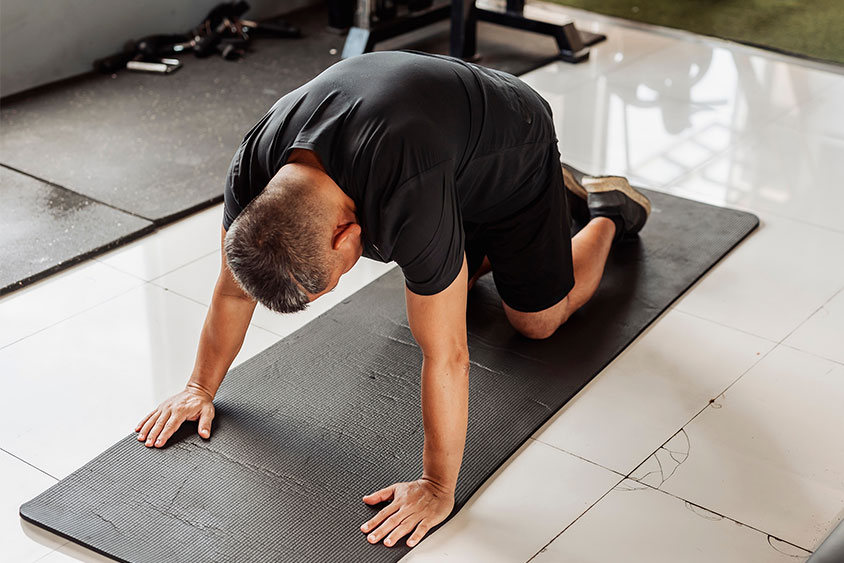
1. Cat Stretch
The cat stretch moves your spine through flexion and extension while encouraging movement through the pelvis and rib cage. It can help get your back moving after sitting, sleeping, or staying in one position for a long time, and it supports motion between the vertebrae.
Try it: Begin on your hands and knees with your shoulders over your wrists and hips over your knees. Slowly round your spine toward the ceiling, allowing your head and tailbone to follow. Reverse the movement by gently extending your spine and lifting your chest forward. Continue moving between the two positions for 6 to 10 slow repetitions.
Everyday benefit: A spine that moves well can make bending, reaching, turning, and transitioning between positions feel easier.
You are only as young as your spine is flexible.
2. Open-Book Rotation
Your thoracic spine, or middle and upper back, is designed to rotate. When that motion is limited, your neck, shoulders, or lower back may compensate, which can contribute to discomfort or tightness.
Try it: Lie on your side with your knees bent and stacked. Extend both arms in front of you with your palms together. Keeping your knees together, slowly rotate your top arm open toward the opposite side of the room, allowing your chest and upper back to rotate with it. Return to the starting position and repeat 5 to 8 times before switching sides. Move only as far as you can without forcing your shoulder toward the floor.
Everyday benefit: Rotation helps with everything from checking your blind spot while driving to reaching behind you or turning to grab something.
3. Shoulder Wall Slides
Your shoulders need to move well overhead for many everyday activities, but shoulder mobility also depends on how your shoulder blades and rib cage move together.
Try it: Stand with your back against a wall, or slightly away from it if that feels more comfortable. Bend your elbows and bring your arms into a goalpost position. Slowly slide your arms upward while keeping your ribs relatively quiet rather than arching your lower back to gain additional range. Lower and repeat for 6 to 10 repetitions. Your hands do not need to stay against the wall. Work within the range you can control.
Everyday benefit: Overhead mobility makes it easier to put something on a high shelf, wash your hair, reach into a cabinet, or lift something overhead.
If cycling or prolonged sitting contributes to rounded shoulders or upper-back stiffness, ACTIVE's daily mobility exercises for cyclists offer additional shoulder and thoracic-spine work.
4. 90/90 Hip Switches
The hips don't just move forward and backward. They also need internal and external rotation. The 90/90 hip switch works both directions, asking you to move actively between positions rather than simply holding a stretch.
Try it: Sit on the floor with your knees bent and feet wider than your hips. Keeping both feet relatively still, slowly lower both knees toward one side. Bring them back through center and lower them to the other side. You can place your hands behind you for support or keep them in front of your body to make the movement more challenging. Continue alternating sides for 6 to 10 repetitions.
Everyday benefit: Hip rotation helps with walking, squatting, changing direction, getting in and out of the car, and moving up and down from the floor.
Runners looking for more targeted exercises can also try ACTIVE's hip-strengthening and mobility exercises.
5. Half-Kneeling Hip-Flexor Stretch With Reach
Long periods of sitting keep the hips flexed. A half-kneeling stretch allows you to move the hip in the opposite direction while adding movement through the side of the body.
Try it: Begin in a half-kneeling position with one knee on the floor and the opposite foot forward. Gently tuck your pelvis and shift your body forward until you feel a stretch across the front of the kneeling-side hip. Reach the arm on that same side overhead and slightly toward the opposite side. Hold for 3 to 5 breaths, then return to the starting position. Repeat 2 to 3 times before switching sides.
Think about getting longer through the front of the hip rather than simply pushing your pelvis as far forward as possible.
Everyday benefit: Hip extension is an important part of walking and running and can become especially limited when you spend much of the day sitting.
Quick Tip
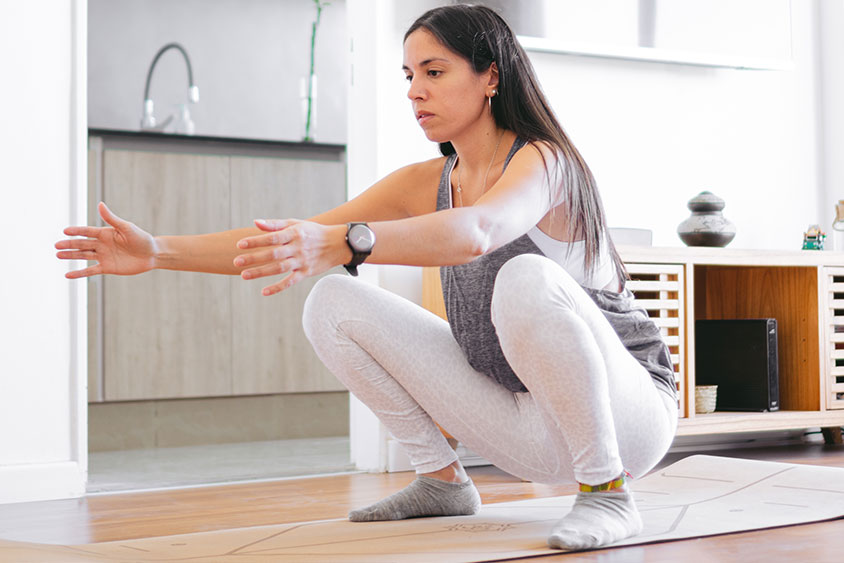
6. Deep Squat Hold
The deep squat is a full-body mobility check. It asks your ankles, knees, hips, and spine to share the work while you stay balanced and controlled near the floor.
Try it: Stand with your feet about hip- to shoulder-width apart, with your toes turned out slightly if that feels more natural. Lower into a comfortable squat, allowing your knees to track in the direction of your toes. Keep your heels grounded if possible and your torso as upright as is comfortable. Hold for 20 to 30 seconds while breathing steadily.
If the position feels too demanding, hold onto a sturdy countertop, railing, or doorframe for support, or place a folded towel under your heels.
Everyday benefit: A comfortable deep squat can help you get down toward the floor, stand back up, garden, play with children, and move through lower positions.
How Often Should You Work on Mobility?
A few consistent minutes can be enough to build the habit. Mobility work can fit first thing in the morning, during a movement break, before a workout, or in the evening before bed. A systematic review and meta-analysis found that stretch training performed regularly for at least two weeks can increase joint range of motion.
Start with a short routine you can repeat. You might choose two or three exercises that address the areas you use most or that feel especially restricted, then rotate through the full list during the week. ACTIVE's collection of stretches for flexibility provides additional options.
The Bottom Line
Mobility gives your body options. The more easily your joints move through the ranges you need, the easier it is to reach, rotate, squat, walk, exercise, and navigate daily life. Try each exercise, notice your starting point, and see how it changes with regular practice.
Frequently Asked Questions
What is the difference between mobility and flexibility?
Flexibility describes the available range of motion around a joint, while mobility adds the strength, coordination, and control needed to move through that range. Mobility helps you use your flexibility during everyday movement and exercise.
How often should I do mobility exercises?
You can practice mobility regularly, even daily, as long as the exercises remain comfortable and controlled. A short routine performed consistently is usually more useful than an occasional long session.
Should mobility exercises hurt?
No. You may feel mild tension or effort, but mobility work should not cause sharp pain, pinching, numbness, or worsening discomfort. Reduce the range, add support, or stop the exercise if pain occurs.
When is the best time to do mobility exercises?
Mobility work can fit into a morning routine, a movement break, a dynamic warm-up, or an evening routine. Before exercise, favor controlled movement through comfortable ranges rather than long, intense static holds.
How long does it take to improve mobility?
Your experience will depend on the joint, your starting point, past injuries, activity level, and consistency. Research indicates that repeated stretch training over at least two weeks can improve range of motion, but lasting mobility also requires control and strength within that range.
About the Author

Kristina Duffy is a Pilates Instructor and movement specialist who helps active individuals return to pain-free movement after injury, pregnancy, or prolonged time away from sport. Working with a wide range of bodies and experience levels, she specializes in core rehabilitation, strength restoration, and sustainable training practices that support long-term performance and pain-free living. Kristina’s approach emphasizes building body awareness, reducing fear around movement, and building confident strength so clients can live and perform at their best.
Get ACTIVE on the Go


Couch to 5K®
The best way to get new runners off the couch and across the finish line of their first 5K.
Available for iOS | Android


Discuss This Article