
"I'm great on the swim and the bike, but I fall apart on the run." If that sentence has ever bounced around inside your head, you're in good company. For so many age-group athletes, the hopes of a strong finish get snuffed out in the first few kilometers of the run, with legs cramping, heart rate spiking, and that dreaded Ironman "death march" shuffle setting in.
Learning how to improve your running leg in a triathlon is the single highest-leverage thing most triathletes can do to transform their race.
Why Trust Us?
ACTIVE.com's editorial team relies on the knowledge and experience of fitness and wellness experts, including competitive athletes, coaches, physical therapists, nutritionists, and certified trainers. This helps us ensure that the products we feature are of the highest standard. Collectively, the team has spent countless hours researching equipment, gear, and recovery tools to create the most accurate, authentic content for our readers. Customer satisfaction is also a key part of our review process, which is why we only feature highly rated products.
Here's the encouraging truth: you don't need to be born a runner to reach your race goals. I've been in your shoes and know the frustration of logging mileage without getting faster. With the right training and technique, you can finish the run feeling strong.
Why the Run Is Where Triathlons Are Won and Lost
Of the three disciplines, the run has the biggest impact on your finish time. A bad swim might cost you 5 to 15 minutes. A rough bike, maybe 20 to 40 minutes. But a bad run can add hours. When a triathlon falls apart, it almost always happens on the run, which is exactly why it deserves the bulk of your attention.
The Unique Challenge of Triathlon Running
Here's a concept that surprises most people: triathlon running isn't really like standalone running races. An open 5K, 10K, or marathon is a speed run in which you start on fresh legs and go as fast as possible. Triathlon running is a strength run, a completely different skill.
What makes the triathlon run different:
- You start on already-tired legs after hours of swimming and biking
- You're carrying muscle damage from a hard cycle leg
- You run at a submaximal effort, so it's about control, not all-out speed
- The goal is not slowing down; a steady pace beats chasing raw speed
- Muscular durability matters more than top-end gears
How Fatigue From the Swim and Bike Affects Your Run
When you hop off the bike, your body faces a sudden challenge. For hours, you've been horizontal in the water, scrunched over the bars, with your weight supported. Then you stand up and start running, and for the first time all day your body has to hold itself upright and re-route blood flow to your running muscles.
If your body hasn't practiced that transition, the result is fatigue, cramping, jelly legs, and a heart rate that feels like it's going to explode. Push too hard in those first few kilometers, and you'll blow up, undoing all the work from the swim and bike. Running well off the bike has to be trained deliberately, which is exactly what brick workouts are designed to do.
What Separates a Strong Triathlon Runner From the Pack
You might think fast triathlon runners are simply built for it, all feather-light with perfect genetics. For 99% of us, that's not the story. You don't need elite genetics, a super-low body weight, or hundreds of pounding miles to become a strong triathlon runner.
It comes down to two things: the right training that makes you durable, and the right technique that conserves your energy. Plenty of athletes run mile after mile without getting faster because they train the wrong way. Get the approach right, and the real goal of holding a steady pace without slowing down becomes achievable, whatever your athletic background.
Building the Engine: Aerobic Fitness for Triathlon Running
Before we talk about speed, we have to build the engine. Your aerobic system is the foundation of every good triathlon run, and the way you build it is probably the opposite of what your instincts tell you.
Why Easy Running Makes You a Faster Triathlon Runner
Here's the principle that changes everything: make your easy efforts faster so your fast efforts feel easier. You want to run as much as possible at a low intensity so your low-end aerobic fitness becomes rock solid, to make your slow Zone 2 runs as fast as they can be at that easy effort. Most triathletes ruin this by running their easy days too hard, living in a gray zone that's tiring but not productive.
Running at a slow Zone 2 effort, and not above it, does two crucial things at once. It builds a dense network of mitochondria, the tiny engines inside your muscle cells that produce energy, and it does so while keeping you fresh instead of digging a fatigue hole. Over months of consistent, capped-effort running, the same pace starts coming at a lower heart rate.
The results speak for themselves. Athletes who run a lot under their heart rate cap (even if they have to walk at first) come back months later running 10K splits minutes faster while it feels easier. One athlete I know dropped 10 minutes off an Olympic-distance 10K and later took 55 minutes off a 70.3. Slowing down is what lets them speed up.
Raising Your Lactate Threshold to Run Faster
Once you've built that big aerobic base and a strong network of mitochondria, you need to teach those new engines how to work hard. That's the job of one fast interval session per week, run when you're extremely fresh so that you can push genuinely hard.
Layering real intensity on top of a big aerobic base raises the effort at which lactate starts to accumulate faster than your body can clear it. In plain terms, your body gets better at running fast while staying in a controlled, sustainable, submaximal zone. Since even a short Sprint is a controlled effort, pushing your lactate threshold higher means you can hold a quicker pace for hours without tipping into the red, which is exactly what a strength run demands.
Structuring Your Triathlon Training Week for Run Gains
Here's the good news for your schedule: you only need three key run workouts per week to become a great triathlon runner. Because swimming and cycling build so much of your general fitness, you can skip all the extra junk miles that pure runners rely on.
A simple weekly structure looks like:
- One or more easy runs at a capped low heart rate, run as often as your schedule and freshness allow, to build aerobic fitness and mitochondria
- One intense run per week, done when you're fresh, with genuinely hard fast intervals
- One brick run to practice running at and above race pace off the bike (more on this below)
- One long run, your endurance builder and the non-negotiable, year-round workout
Whatever you do, don't stack these so aggressively that you show up to race day overtrained.
Being 80% trained but 100% rested beats being 100% trained but only 80% rested every single time. Freshness is a weapon; guard it
Key Workouts to Improve Your Run in a Triathlon
Three workouts do virtually all the heavy lifting: the long run, the brick run, and the intense run. Master these, and you've mastered triathlon run training.
Brick Workouts: Running Strong Off the Bike
A brick run, running immediately off the bike, trains the separate skill of transitioning from cycling to running. It teaches your body to quickly re-route blood flow so you avoid the cramped, locked-up, jelly-legs disaster that ambushes so many first-timers. Just as important, the brick run is where you get used to running at and above your race pace on legs that are already tired, ideally after your longest bike of the week. That combination is exactly what race day feels like, so it's the most race-specific rehearsal you can do.
Most of the year your brick runs stay easy and short, since your endurance and speed come from the other two workouts. As a race approaches, you sprinkle in one brick run per week, with a section at or above race pace, so your body learns to sustain that effort off the bike without blowing up. For a deeper dive into structuring these sessions, see this guide to brick training for beginners.
Rough minimums to have in your legs before race day:
Quick Tip
- Sprint and Olympic: about 6 brick runs
- 70.3 (Half-Ironman): about 20 brick runs
- Full Ironman: about 40 brick runs
Interval and Threshold Workouts for Speed
Speed is the separator between merely finishing and actually racing. The number-one mistake triathletes make is not running hard enough. They do runs that are "a little bit hard and a little bit long," and never improve. A truly intense run must be genuinely hard to trigger the adaptation that forces your body to get faster. When you do interval work, do it intensely.
High-level session types to rotate through the season:
- Short hill sprints, powerful near-maximal bursts to build strength and stride power
- Long hill intervals, sustained hard climbing efforts
- Short intervals, fast repeats with full recovery
- Long intervals, longer reps closer to threshold pace
The Long Run for Triathletes
The long run builds the endurance to complete your race distance feeling strong on tired legs, and endurance builds far more easily than most athletes think. You don't need endless pounding long runs; you need consistency and the right pacing. The key is capping your heart rate so the run stays truly aerobic.
To find your heart rate cap, use the Maffetone Method:
- Subtract your age from 180 (for example, a 36-year-old: 180 minus 36 = 144)
- Subtract 10 if you're recovering from a major illness or injury in the past year
- Subtract another 5 if a cold or injury disrupted your training for 2 or more weeks
- Add 5 if you've trained consistently for 2 or more years with no health problems
Then refine by feel: you should be able to hold a conversation. If your breathing is too strong to chat, lower the cap and always err on the side of a lower number. The cap is the cap regardless of hills, wind, or terrain, so walk if you must at first. And don't panic if your heart rate slowly climbs over the first 90 minutes; that's normal cardiac drift.

Running Efficiency: How to Run Faster With Less Effort
Better running efficiency, sometimes called running economy, is essentially free speed. When you waste less energy per stride, the same effort carries you faster. For longer-distance triathletes especially, small improvements in economy add up to minutes saved over a 70.3 or Ironman run.
Improving Your Running Form and Cadence
Forget the dogma that you must land on your forefoot. For most age-groupers, a mid-foot or even heel strike is perfectly fine, since the total impact force is similar either way. Chase smooth and relaxed, not textbook-perfect. Run tall with a slight lean from the ankles; keep a quick cadence with shorter, lighter steps to avoid overstriding; relax your shoulders and hands; and let your feet land underneath you rather than way out front.
Why Strength Work Makes You a Faster, More Durable Runner
If there's one supporting piece of the puzzle worth prioritizing, it's strength work. Study after study finds that strength training improves running economy, meaning you use less energy to hold the same pace. In a long-distance triathlon, where you're running for one to four-plus hours on tired legs, that efficiency is enormous.
Strength work does something else just as valuable: it makes your body more durable. Stronger, more resilient muscles resist the breakdown that causes the classic late-race blowup. They won't get as sore, your posture will hold together deeper into the run, and you'll dramatically reduce the odds of a catastrophic failure on race day. To make this work:
- Prioritize sport-specific strength that transfers to running, not just generic gym lifts
- Run your long runs on hills when you can, which builds durable, race-ready muscle better than the flats
- Include a dedicated strength session in your week, treating it as one of your key non-negotiable workouts
- Focus on the posterior chain, glutes, hamstrings, and core, which keep you upright and powerful when fatigue sets in
Dialing In Your Bike to Set Up a Faster Run
Here's a truth many athletes miss: your run is set up by your bike. When a run falls apart, the cause is often what happened on the cycle leg. Nail your bike pacing, and you give yourself the platform for a strong run.
How You Pace the Bike Determines Your Run
The goal on the bike is to arrive at T2 slightly taxed but completely able to run well. Bike too hard and you'll cook your legs; bike too timidly and you leave time on the table. The way you find that line is through your long brick workouts, biking and then running while paying attention to how your legs respond.
If your brick run feels stiff, crampy, or fades badly at the end, you likely biked too hard and need to back off. Repeat these sessions, and you'll learn exactly what bike effort sets up your best run.
Managing Effort From Sprint Distance to Ironman
Rather than chasing a rigid power or heart-rate number, pace your bike by rate of perceived exertion (RPE), which adapts to conditions and how you feel:
- Sprint: 8/10
- Olympic: 7/10
- Half-Ironman (70.3): 6 to 7/10
- Ironman: 6/10
Use these RPE targets during training to find your corresponding heart rate or power numbers. Then you'll head into race day knowing the effort and the numbers that leave you ready to run.
Race Day Strategy for Your Triathlon Run
You've done the training. Now it's about execution. Often, less is more, so stay calm and keep your run strategy simple.
Pacing the Run to Avoid Fatigue and Blow-Ups
Don't blast out at your target race pace from the first step. Instead, ease in and pace by feel, breaking the race into manageable chunks. "Run 10.5 km four times" is far less daunting than "run 42.2 km," and chunking takes the mental load off.
Then listen to your body:
- If target pace feels awful early, back off and rebuild toward it later
- If it feels easy in the final 25%, pick it up and turn the screws on your competitors
- When in doubt, protect against the blow-up, since a steady finish beats a fade every time
Fueling and Hydration for a Strong Run
You can be perfectly trained and still fall apart if your nutrition isn't dialed in. The two things that wreck a triathlon run are running out of steam (bonking) and GI distress, both of which are preventable with a simple, rehearsed plan.
Keep race fueling simple. Estimate the calories you'll burn based on your race distance, pace, and body weight, then aim to replace about 25% of that during the race, which studies show is the sweet spot your stomach can absorb without bloating. Take your calories in small doses at even intervals, roughly every 20 minutes, since digestion is impaired while racing, and small, frequent servings are far easier on the gut. For fluids, sip a light electrolyte drink at about 1 bottle per hour, then adjust up or down based on how your stomach feels. For more on dialing this in, see these triathlon nutrition tips for race day.
Above all, nothing new on race day. Practice your exact fueling on your race-pace brick runs in the weeks leading up to your race so your gut is trained to handle it. A trained stomach is the difference between finishing strong and spending the last hour in a portable toilet.
Fat-Burning Training for Longer Races
For longer races, particularly 70.3 and Ironman, there's a second fueling weapon: teaching your body to burn fat as fuel. Here's why it matters. You can only store around 2,000 calories of glycogen and absorb maybe 240 calories per hour during a race, but an Ironman can burn 12,000 calories.
That gap is why so many athletes bonk in the back half. Your body carries a near-limitless supply of energy in fat, and training it to tap that reserve closes the gap. A carb-only athlete burning 0.5 grams of fat per minute faces a big shortfall over a long race, while a fat-adapted athlete burning 1.2 grams per minute can run a calorie surplus and hold pace to the line.
You build this by doing some of your long, low-intensity sessions with reduced carbs, forcing your body to get efficient at using fat. Ease into it gradually rather than slashing carbs overnight, and keep your hard speed and strength sessions fueled with carbs so you can still hit them. Then, in the final six weeks, practice your full race-day carb intake on your most race-like workout so you arrive able to both burn fat and take on race fuel.
Mental Strategies When the Run Gets Hard
The run will get hard; that's the nature of a strength run. How you manage your mind matters, because mental strain directly affects physical performance. Keep chunking the distance, stay positive, and talk to yourself the way you'd encourage a training partner.
A calm, focused mind holds your pace together when your legs start to complain. The athletes who finish strong are the ones who stay mentally in the race all the way to the line.
The run is where triathlons are won and lost, and it's a strength run on tired legs, not a speed run. You build it by running as much as possible easy at a capped heart rate to grow your aerobic base and mitochondria, running one genuinely hard interval session per week when you're fresh, and using brick runs to get comfortable at and above race pace off the bike.
Support it all with strength work for economy and durability, come into your race rested rather than overtrained, and nail your nutrition, including fat-burning for the longer distances, so you never run out of steam.
None of this requires elite genetics or monster mileage, just the right training and the right technique. With that approach, any age-group athlete can cross the line having run the leg they always knew they were capable of. You can finish the run feeling strong, and your race goals are well within reach.
Frequently Asked Questions
Why do my legs feel so heavy running off the bike?
Because running off the bike is its own skill, after hours in the water and on the cycle, your body has to suddenly hold itself upright and re-route blood flow to your running muscles, which causes that heavy, cramping, jelly-legs feeling. The fix is brick workouts, practicing the bike-to-run transition until your body adapts.
How many times a week should a triathlete run?
For most age-groupers, three key run workouts per week is plenty, because swimming and cycling build the rest of your fitness. If you're short on time, prioritize the long run above all else and treat it as your non-negotiable, year-round workout.
What workouts make you a faster triathlon runner?
The intense run is your speed driver, but only if you run it genuinely hard with true intervals, and only when you're fresh enough to push. Pair it with easy, heart-rate-capped runs that build your aerobic base and mitochondrial capacity, plus a long run for durability. Speed comes from real intensity on a rested body.
How do I stop slowing down at the end of the triathlon run?
Fading usually traces back to going out too hard, either on the bike or the early run. Build endurance with long runs, dial in a bike effort that lets you run well, and pace the run by feel in chunks. The goal of a strength run is simply not to slow down, so start controlled and finish strong.
Do brick workouts really help your triathlon running?
Absolutely, and they may be the most race-specific workout you can do. Bricks teach your body to handle the bike-to-run transition so you don't lock up in the first kilometer. Aim for roughly 6 bricks for a Sprint or Olympic, about 20 for a 70.3, and about 40 for a full Ironman before race day.
About the Author
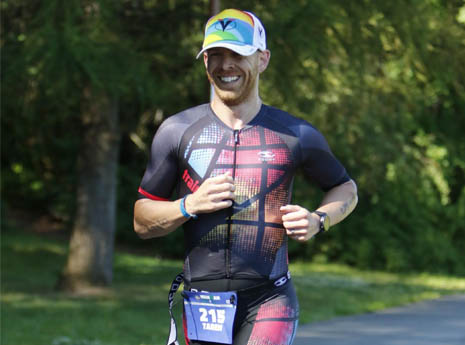
Taren Gesell was a leading global voice in triathlon, publishing the Triathlon Foundations book series and hosting the world’s largest triathlon podcast. He is a former world-ranked triathlete, record-setting marathon swimmer, and founder of the voice-AI training app MOTTIV.
Get ACTIVE on the Go


Couch to 5K®
The best way to get new runners off the couch and across the finish line of their first 5K.
Available for iOS | Android






Discuss This Article