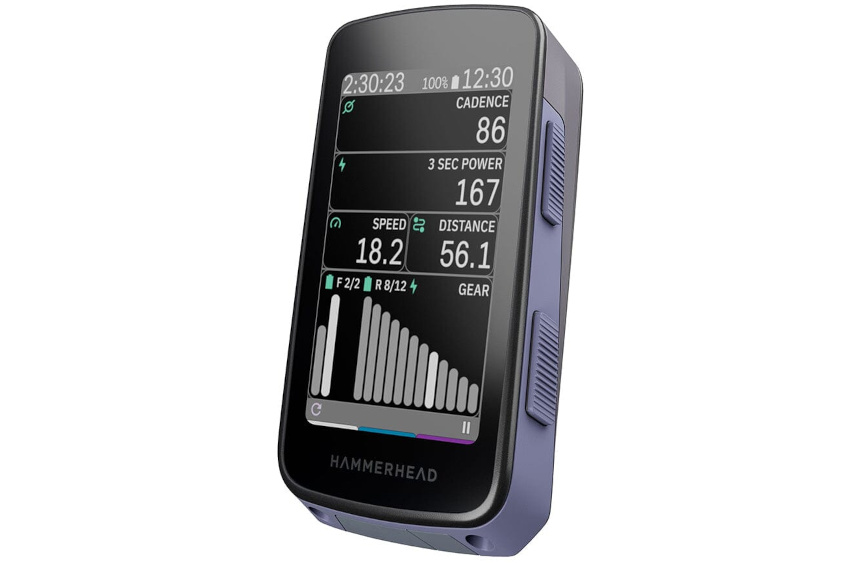
The latest bike computers, sometimes called head units, do more than display speed, distance, time, and cadence. They are the centerpiece for ride and physiological metrics pulled from your surroundings, bike, and body sensors.
While some cyclists may still use phones strapped to handlebars instead of a dedicated bike computer, we’re not fans of this. Saving one’s phone’s battery for when it's needed is preferable, and even the most secure handlebar mounts risk failure, sending your mobile clattering onto the concrete.
Why Trust Us?
ACTIVE.com's editorial team relies on the knowledge and experience of fitness and wellness experts, including competitive athletes, coaches, physical therapists, nutritionists, and certified trainers. This helps us ensure that the products we feature are of the highest standard. Collectively, the team has spent countless hours researching equipment, gear, and recovery tools to create the most accurate, authentic content for our readers. Customer satisfaction is also a key part of our review process, which is why we only feature highly rated products.
We looked at a few of the dozens of bike computers, weighing criteria such as battery life, screen size, map and navigation features, and more, to sort the best from the rest.
Features common to the best bike computers
All the devices in this best bike computer list share a few common features that are neither distinguishing nor disqualifying.
Unlike the best wearable GPS devices, the best bike computers offer ANT+ for connecting to external sensors and WiFi for over-the-air updates and file uploads. All offer BTLE secure and power-sipping connections to sensors, too. The bike computers in this roundup also all have onboard barometric altimeters, which offer a high level of precision for elevation change.
And gone are the charging cables specific to each brand; USB-C is the norm for these best bike computers.
Wahoo, Garmin, Bryton, Hammerhead, and others feature proprietary device dashboards in mobile and/or web browser versions. All seamlessly connect to TrainingPeaks, Strava, RideWithGPS, Komoot, and other free and paid services for route mapping, performance analysis, and data visualization.
All devices include some sort of live tracking feature when connected to a mobile phone — but so do mobile phones. Note that we did not dig into indoor device usage; check out Zwift or MyWhoosh for your indoor cycling. All devices are FE-C compatible, allowing them to communicate with smart trainers.
Best bike computer battery claims
The noted differences between cycling electronics, even those from the same manufacturer, are mostly objective. Sure, size, weight, and battery life are important, but we wanted to go beyond the obvious and call out why one device stands apart from others.
We took manufacturers’ claims about battery life with a few (large) grains of salt. Companies usually proclaim hours of energy storage available. Still, these estimates may be based on best-case scenarios, in a nearly clinical setting, with computers configured to stretch battery reserves to the maximum.
While some brands promise 30 or more hours of GPS use, the reality is that bike computers’ battery life greatly depends on how and where they are used. Satellite reception, screen size and brightness, the number and type of external wireless sensors connected, and a few other battery-depleting factors mean the actual hours between charges are often less than claimed.
It's worth noting that a rear-facing radar, while a life-saving bit of tech, is very signal-intensive. According to one manufacturer, a radar may cause a bike computer battery to drain by as much as 20%.
Also worth calling out is the amount of onboard storage on the device. If you’re a world traveler with your bike, consider a computer with more storage so that you can upload more maps and routes. You might also consider a device with advanced mapping, so you don't always have to glance at the screen for routing.
Bike computer features wish list.
Other features that make our wish list but are not disqualifying if absent include color-coded climbing profiles, spoken turn-by-turn navigation, a return-to-home function, auto-brightness adjustment for display visibility and battery life, weather alerts, and whether a device is part of an ecosystem.
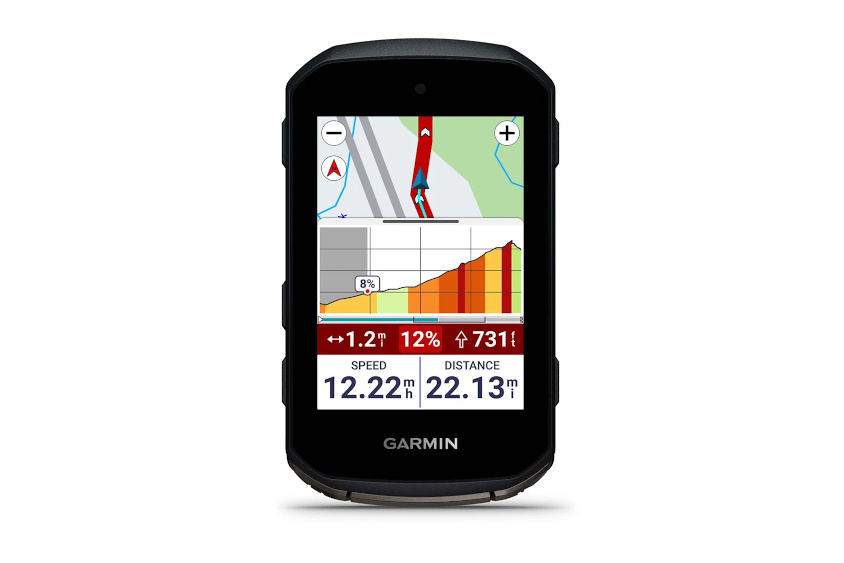
Best bike computer: Garmin Edge 850
Price: $599
Enclosure dimensions: 92.2 x 54.6 x 16.8mm
Screen size (diagonal): 68mm
Screen Type: Transmissive LCD touchscreen
Weight (claimed): 113g
Battery life (claimed): 12hrs
Storage: 64GB
Buy the Garmin Edge 850 from Amazon
Topping our list of best bike computers is the Garmin Edge 850 with its 16 million color display and “Goldilocks” form factor. It’s big enough to see data fields easily, but not cumbersome.
The Edge 850 offers the same features as the larger Edge 1050 ($699) but in a smaller form factor and weighs a few grams less. The Edge 850 offers notable improvements in touchscreen performance over the Edge 800 series when riding in the rain. For those who prefer buttons, the Edge 850 features seven. A speaker provides voice navigation, a digital bell, and a theft-deterring alarm.
Known for its navigation electronics for motorsports, marine, and aviation, Garmin dialed up the GPS accuracy on the Edge 850; the onboard barometer offers additional precision. Equipped with 5Hz GNSS sampling, maps and navigation are quick to update, making it less likely you’ll blow by and miss a turn.
A tradeoff for the bright, easy-to-read transmissive LCD touchscreen, onboard magnetometer, accelerometer, and gyroscope is battery life, which may last about 12 hours (Garmin indicates an optimistic 36 hours in the most conservative mode) between charges.
Other really handy features of the Edge 850 for the serious cycling crowd include the PowerGuide planning guide, fueling recommendations, heat- and altitude-adjustment calculations, and a coaching tool to help you prepare for and execute at specific events. The latest generation of Garmin Edge devices offers a hazard reporting system (reliant on user-submitted reports), similar to Waze.
I really like the integration of devices in the Garmin ecosystem. The Edge 850 might be the centerpiece of a crown of cycling devices, including a wrist-wearable for 24/7 physio monitoring, a pedal-based power meter, a rear-facing radar, and a heart rate chest strap. The Garmin Connect dashboard—mobile and desktop—offers device management, as well as viewing rider performance metrics, mapping, and more.
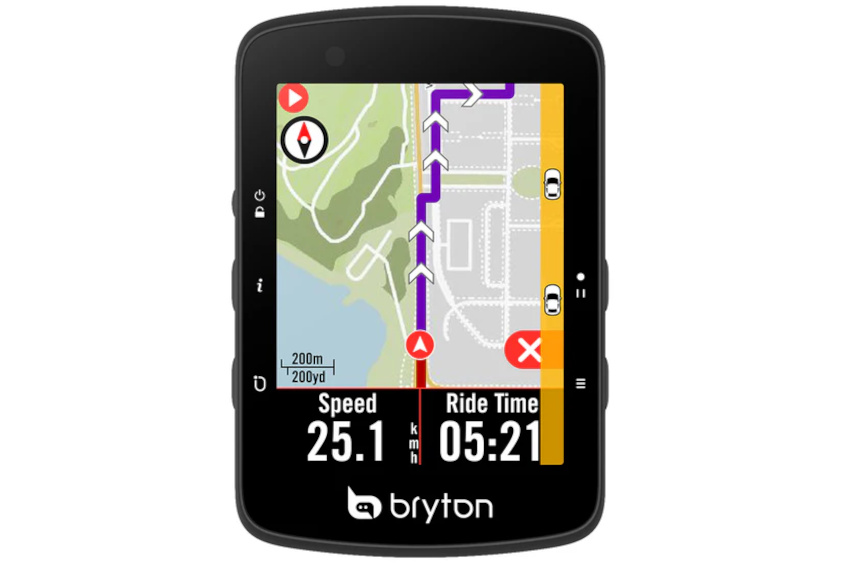
Best value bike computer: Bryton Rider 650
Price: $190
Enclosure dimensions: 84.5 x 56.8 x 16mm
Screen size (diagonal): 71mm
Screen Type: TFT Capacitive Touch Screen
Weight (claimed): 92g
Battery life (claimed): 33hrs
Storage: 8GB
Buy the Bryton Rider 650 from Amazon
The least expensive, full-featured, color touchscreen bike computer on our recommended list is the Bryton Rider 650. Costing about one-quarter as much as the most expensive head units, the Rider 650 doesn’t skimp on features.
Like pricier options, the Rider 650 also uses multiple satellite constellations—GPS, Glonass, Galileo, BeiDou, and QZSS—for navigation. Mapping and turn-by-turn routing can be set on-device or via the Bryton Active mobile app, which can be used to configure the device and set up to 3 different bike profiles, with up to 10 data fields per screen.
Labelled buttons, including one that’s programmable, sit proudly on the sides of the unit and can be used when riding in the rain or when wearing gloves that might be too bulky to use the touchscreen precisely.
Even with the ambient light sensor enabled in a power-sipping setting, when accessories such as a power meter or radar are connected, the claimed 33 hours of battery may be closer to 15 hours between charges, which is about average for bike computers in 2026.
The Rider 650 pairs easily with Bryton's Garda series radars, as well as with devices from Garmin, Wahoo, and others.
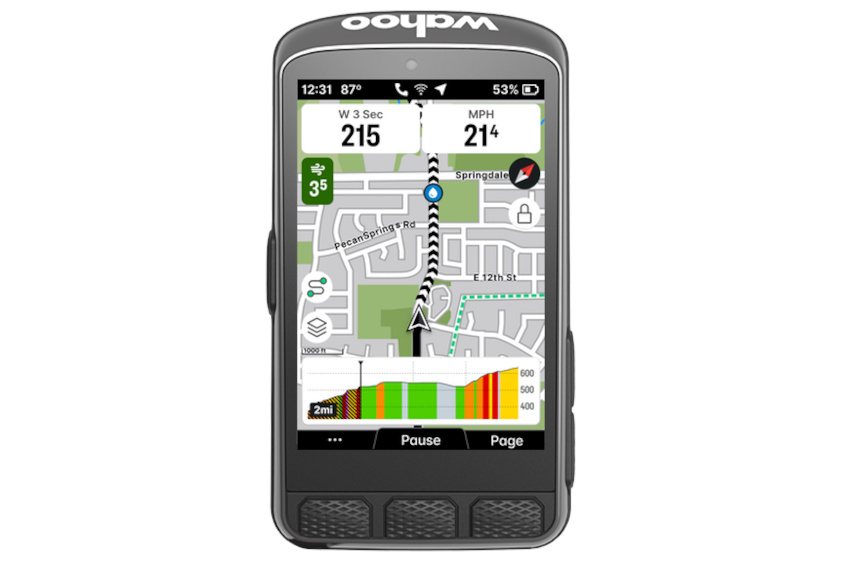
Best bike computer with a large display: Wahoo Element Ace
Price: $625
Enclosure dimensions: 126 x 71 x 24mm
Screen size (diagonal): 96.7mm
Screen Type: Transflective TFT touchscreen
Weight (claimed): 208g
Battery life (claimed): 12hrs
Storage: 64GB
Buy the Wahoo Elemnt Ace from Amazon
One of the big players in cycling electronics offers a big screen bike computer, the Wahoo Elemnt Ace. This head unit makes our list as a good buy for cycling computers with easy-to-view, reliable navigation, device ecosystem integration, and novel features.
A sensitive touchscreen might be finicky to use; however, buttons allow for fumble-free device operation. Those familiar with Wahoo will appreciate a familiar button layout.
I like Wahoo’s display zoom feature—which is accessed from the side rocker buttons—for toggling the number of data fields displayed on screen. I’ve found this handy, for example, when I want to change the data presented while climbing, riding on flat roads, or sitting in a group.
The Elemnt Ace features a barometer, altimeter, accelerometer, and compass. Oh, it also includes a digital bell. Wahoo says that, due to the size of the unit, some cyclists might need a third-party mount (an aluminum one is included) to work with their specific cockpit configuration.
While Wahoo promises more than 30 hours between charges, real-world battery life may be closer to 12-15 hours due to screen size, GPS availability, brightness, and other factors.
The unique Wahoo Wind Dynamics sensor detects relative air speed, which, according to Wahoo, is calculated from the air pressure measured by the device’s pressure sensor, based on the bike's current speed and other conditions. This data can be presented on screen, with color coding to highlight the relative effect of the wind. It approximates the speed impact of wind conditions on a rider. To be sure, this feature does not calculate drag coefficient; it indicates wind assistance/hindrance from tail/head wind, and the drafting effect.
Like Garmin, Wahoo’s ecosystem of sensors, trainers, and other devices just work really well together. The Elemnt Ace does just as well if you’re not using all Wahoo-branded electronics, like drivetrain and shifting systems.
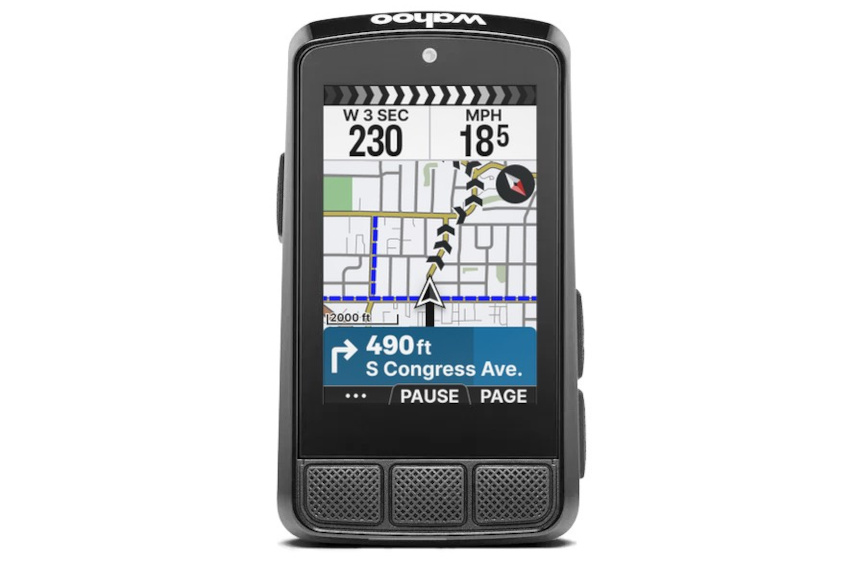
Best bike computer for simplicity: Wahoo Elemnt Bolt 3
Price: $349
Enclosure dimensions: 83 x 47 x 24mm
Screen size (diagonal): 58mm
Screen Type: Transflective TFT
Weight (claimed): 84g
Battery life (claimed): 15hrs
Storage: 32GB
Buy the Wahoo Elemnt Bolt 3 from Amazon
One of the reasons the Wahoo Bolt 3 makes the list of best bike computers is the move to 64 million colors, from just 64 colors in the previous version—that’s a lot more zeros! The display size increases by 2.5mm, too, and these improvements add just a tiny bit of weight compared with the previous generation. Wahoo removed the horizontal status LEDs from the top of the unit face, further freeing up screen real estate for mapping and metrics. The addition of an always-visible time-of-day in the upper-left corner of the display is also welcome.
Wahoo made updates to the setup, configuration, and ride management features between versions of the Bolt bike computer. Improvements to navigation and mapping—street-name overlay, POIs, satellite reception in wooded overhangs and urban environments, etc.—and the addition of activity profiles (think road, gravel, indoor) are more reasons to buy.
The Bolt 3 doesn’t feature a touchscreen, so you’ll have to go old-school and use buttons to move through screens and display data. As with the Wahoo Elemnt Ace, the Bolt offers a screen zoom feature.
A feature that sets the Bolt 3 (and Wahoo bike computers in general) apart from other devices is the ability to download maps for specific regions as needed, rather than getting bogged down by needlessly cumbersome, massive, storage-hogging map files. To create routes, you’ll need to head over to Strava, RideWithGPS, or Komoot, and create routes for upload to the Bolt.
The Bolt 3 is pretty straightforward and offers a simple, pared-down experience, best for displaying ride metrics, maps, and traffic approaching from the rear when a radar unit.
Best bike computer for SRAM integration: Hammerhead Karoo
Price: $525
Enclosure dimensions: 102.8mm x 61.7mm x 19.9mm
Screen size (diagonal): 82mm
Screen Type: TFT transflective LCD
Weight (claimed): 118g
Battery life (claimed): 15hrs
Storage: 64GB
Buy the Hammerhead Karoo from Amazon
SRAM users rejoice! The latest Hammerhead Karoo integrates with—and is part of the ecosystem that includes—SRAM eTap shifting, Quarq powermeters, Zipp pressure sensors, and more. For Shimano and other component users, a third-party software add-on is required to integrate with EPS, STEPS, and Di2 systems.
Although the Hammerhead Karoo debuted in 2024, twice-monthly software updates keep this bike computer up to date with improvements and new features.
The Karoo leverages Android OS for a mobile-device-like experience, including an on-screen QWERTY keyboard—a unique feature among bike computers. Five external buttons adorn the Karoo, too. The third-generation Karoo improves the Gorilla Glass-protected touchscreen responsiveness, which performs admirably in the rain. While the display is brighter than in previous generations, it may still not be as brilliant as comparable units from Garmin or Wahoo.
A notable navigation feature Hammerhead provides is an alert if you travel with your bike to a region that requires a map not yet on the device. Prompts can step you through downloading and installing free, worldwide maps. Audible navigation alerts may be rather loud, even compared with previous Karoo devices.
If you have more than one bike and/or use your bike in a variety of scenarios (e.g., indoor, train, race, road, gravel, etc.), dig into the profiles feature, which is customizable for different bikes and ride scenarios.
br/> Offering a proprietary mounting system, Hammerhead also offers a mounting adapter for the ubiquitous ¼-turn mount.
By clicking on the product links in this article, we may receive a commission fee at no cost to you, the reader. Sponsorships and affiliate commissions help support our research so we can help you find the best products. Read full affiliate disclosure here.
About the Author

Get ACTIVE on the Go


Couch to 5K®
The best way to get new runners off the couch and across the finish line of their first 5K.
Available for iOS | Android






Discuss This Article