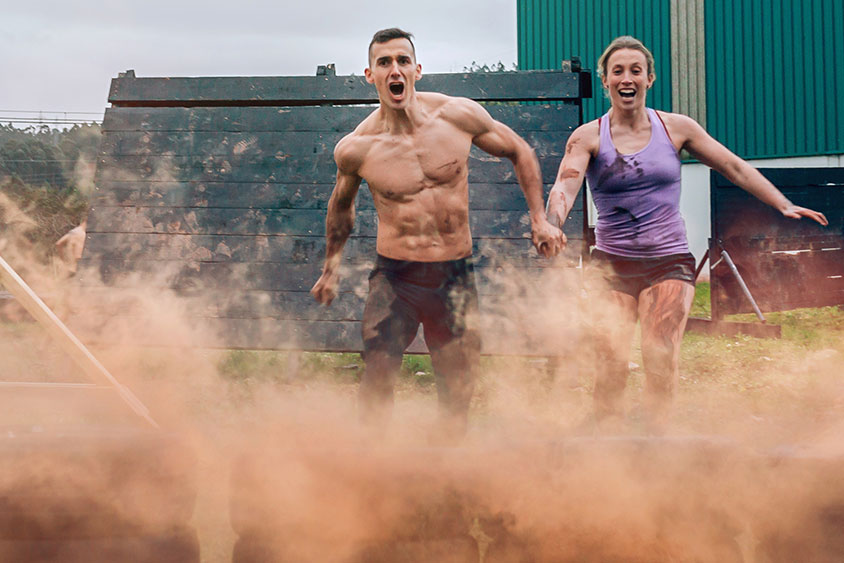
So you’ve signed up for an obstacle course race (OCR), and you’re feeling a little nervous. How exactly does one prepare for an event that is never the same from course to course and is designed to keep participants guessing?
While you can expect to face the unexpected on race day, we’ve got four training tips that will hone the core skills that will serve you best and set you up for OCR success.
Why Trust Us?
ACTIVE.com's editorial team relies on the knowledge and experience of fitness and wellness experts, including competitive athletes, coaches, physical therapists, nutritionists, and certified trainers. This helps us ensure that the products we feature are of the highest standard. Collectively, the team has spent countless hours researching equipment, gear, and recovery tools to create the most accurate, authentic content for our readers. Customer satisfaction is also a key part of our review process, which is why we only feature highly rated products.
Train Your Grip
No matter which OCR you’ve signed up for, you can bet you’ll be hanging from something - and probably many somethings - at some point during your race. If you can keep from dropping off the monkey bars and sliding down those darned ropes, you’ll save an outsized amount of time and energy. That’s why training your grip tops our list.
Before you train your grip, see where you’re at by hanging from a pull-up bar for time. If you can’t hang for at least a minute, just work on that until you can. Start easy, though - the muscles in your hand, wrist, forearm, and elbow are particularly susceptible to injury if they haven’t been stressed much before.
Start with three hangs for a time that feels difficult but doesn’t start to “hurt.” Rest for at least two minutes between each hang.
If you can already hang for a minute or more, then head out to your local playground and see how many trips along the monkey bars you can do before you drop. If you can travel 50 feet or more without dropping, congrats - you’ve got passable grip strength. It could always be better, though!
Train Your Core
The next area of focus should be on your core. That’s because virtually every obstacle you’ll face will call on those muscles, whether it’s balancing on a skinny beam, hoisting a gravel-filled bucket, or climbing an oil-slicked rope.
If, when I say “core,” you think “abs,” we need to talk. Your core includes more than 20 muscles that make up your hips, abdominals, and lower back. The core is the body’s primary stabilizer, but it’s also incredibly dynamic. For an OCR, you’ll want to train both core strength and mobility. Luckily, there are a few exercises that can cover both at once.
Burpees are maybe the perfect OCR exercise, because they require excellent hip mobility as well as abdominal and lumbar strength and stability. Do lots of them - especially if your OCR is of the Spartan variety.
Mountain Climbers are the burpee’s little cousin. Much easier to knock out a set of 10 to 20, but it's still very effective at tuning up your core. Work them into your training frequently.
Good Mornings or Romanian Deadlifts are the third core exercise we recommend because they work the posterior core muscles, which are often neglected and therefore weak. Start easy if you’re new to these, and focus on form and technique. As you get more comfortable, add weight gradually.
Work on Endurance - Both Aerobic and Muscular
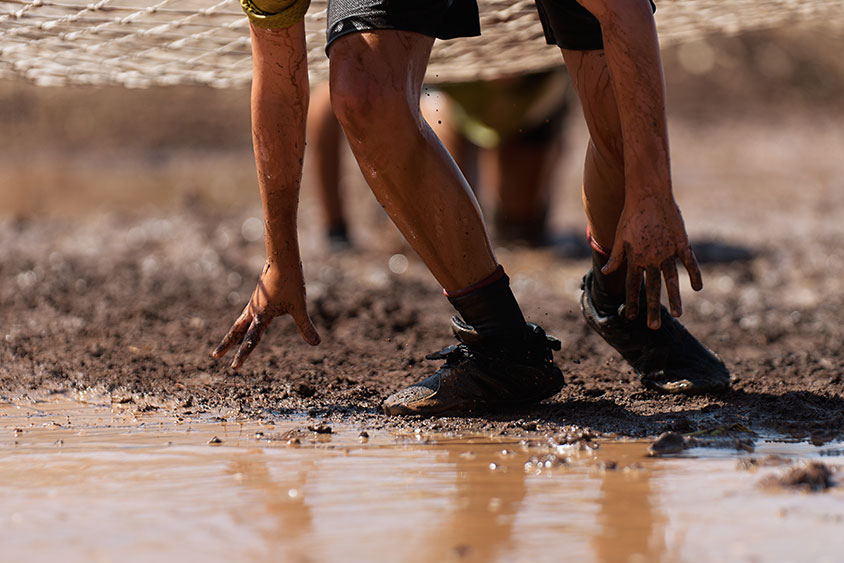
No matter how long your OCR is, it will feel long. There may be 20-40 obstacles, with miles of walking or running in between, often up and down hills and through mud or water. This is all exhausting, and if there’s one thing you don’t want to be on race day, it’s exhausted.
Train for this by doing hard things for as long as you can. One of the best workouts you can do is the driveway carry-run-burpee drill:
- Fill a five-gallon pail with dirt or gravel and set it at one end of your driveway. Start a stopwatch.
- Pick up the bucket and carry it to the other end of your driveway. (Hopefully, your driveway is at least 10 yards long. If not, carry it down and back.)
- Jog briskly up and down your driveway for two minutes.
- Do 10 burpees, then immediately carry the bucket to the other end of your driveway.
- Jog back and forth for 2 minutes, then do 10 burpees. Repeat.
- Start with two or three circuits of this (or whatever feels very challenging), and work your way up to however long you think it will take you to finish your OCR. Yes, really - that long!
Train for Your Race’s Signature Obstacles
A lot of OCR newbies will focus only on this training tip: they’ll research their specific race and practice for the obstacles they expect to face. This is fantastic - if you’ve already got amazing endurance, core functionality, and grip strength. If you don’t, then training the obstacles before race day is time you’ll wish you had spent better. There are three reasons for this:
First, you can’t possibly train for all of the obstacles. In fact, you probably won’t even know what all of the obstacles are. Even if you know the ten or so that are pretty much always included in every OCR, you’re going to spend a lot of money on specialty coaching, gym memberships, or very specific equipment to train for the rope climb, rotating monkey bars, sandbag hoist, medicine ball carry, vertical wall climb, and the list goes on.
Second, while technique can certainly help (definitely watch some videos on how to use your feet when rope climbing), it won’t make up for a lack of strength or endurance. On the other hand, a strong fitness base goes a long way to overcoming a lack of technical expertise.
Finally, the obstacles are only about half the race, time-wise, and a much smaller fraction distance-wise. You need to be able to cover ground (hopefully at more than a crawl), and only by amping up your endurance will you be able to do that.
But hey, you can do both things at once, no? Work on your grip, core, and endurance during your training sessions, and devote a little time on your recovery days or in the evenings to researching your race. Scope out the likely obstacles, other racers’ tips for how to complete each one, the terrain in the specific area where your race will be held, the likely weather conditions - you name it.
The more prepared you can be on race day, the more fun you’ll have. And if you have fun at your first OCR, you’re likely to join the ranks of tens of thousands of repeat obstacle course racers.
About the Author

Rashelle is a long-time fitness professional and writer. She is a regular contributor for NextAvenue and ACTIVE.com, and is the author of Reboot Your Body: Unlocking the Genetic Secrets to Permanent Weight Loss.
Get ACTIVE on the Go


Couch to 5K®
The best way to get new runners off the couch and across the finish line of their first 5K.
Available for iOS | Android



Discuss This Article